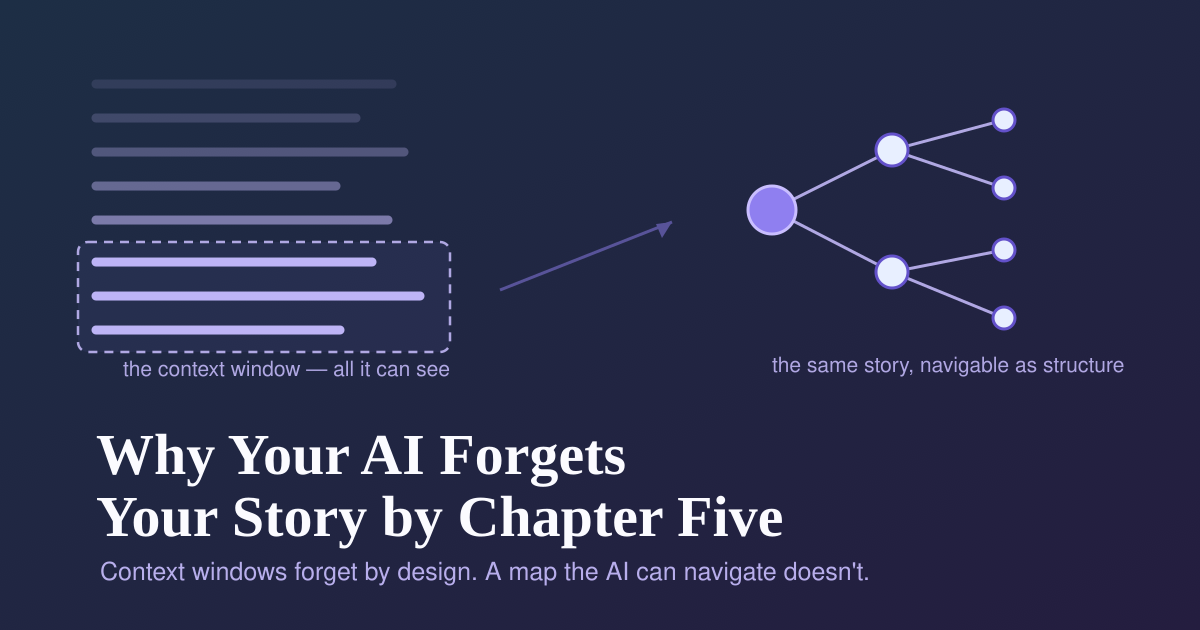
Why Your AI Forgets Your Story by Chapter Five
You know the moment. On page one the AI was sharp — it kept your pace, caught your tone, offered a line that almost sounded like you. By chapter five something has gone wrong. It gives your protagonist the wrong eye color. It writes a scene for a character you killed two chapters ago. It cheerfully helps you break a rule of your own world — the one you spent a careful paragraph establishing — as if you had never written it down.
The reflex is to blame the model. It got lazy. It stopped paying attention. But that is not what happened, and the real explanation matters, because it points at a different fix than the one everyone reaches for.
It isn't forgetting — it never saw it
An AI assistant does not hold your novel in its head. It holds a context window: a fixed budget of text it can consider at once. Everything you want it to know has to fit inside that budget — the current scene, whatever you pasted in, and nothing else. A finished chapter that scrolled out of the window is simply gone from its view. It never forgot the eye color you set in chapter three. It was never looking at chapter three.
And the window is finite by design. It always ends somewhere. A novel — let alone a long-running series — outgrows it every time. Even inside the window, recall thins toward the middle: a detail buried between the opening pages and the line you are writing now is the first thing to slip. So the model is not degrading over the course of your book. Your book is simply growing past the edge of what it can see, and that edge was there from the first word.
This is why a bigger window is a treadmill, not a cure. Double it and your story doubles past it by the next act. The window will always end; long-form and serial fiction will always run longer. Buying more context buys a slightly longer leash on a problem that has no far end.
The fix isn't a bigger window — it's a map
If the AI cannot hold the whole book at once, the goal is not to make it hold more. It is to make the book navigable — so the AI can find the part that matters instead of trying to carry all of it.
That is what Sagaly is being built to do. Sagaly will model your story not as one
long file but as a typed hierarchy —
Universe > Epic > Series > Story > Act > Chapter > Scene — with typed Properties
attached to any element: a character's eye color, a faction's rules, an act's
turning point. Rather than pour the whole novel into a window and hope the
relevant line survives, Sagaly will retrieve the handful of elements that bear on
what you are doing right now, by meaning rather than by keyword.
Sagaly is designed so that structure enables intelligence. That is the principle. The typed hierarchy is where it will stop being a promise and become the mechanism: you cannot search a flat file by meaning across a whole novel and get structure-aware results — but across a typed element tree, you will be able to.
Continuity you'll be able to ask about
Structure the AI can navigate turns continuity from something you hope it remembers into something you can simply ask.
Here the distinction between agentic and generative AI stops being a slogan. A generative assistant is handed a prompt and produces text; an agentic one navigates what you have already built before it responds. Sagaly's collaborator will read the relevant elements of your story before it answers, and it will cite the ones it drew from — so you can see which scenes and notes the answer came from, rather than taking it on faith.
Circle back to that wrong eye color. Instead of scrolling three chapters to check, you will be able to ask, "what did I say about her eyes, and where?" — and get an answer drawn from what you actually wrote, pointing at the scene that established it. That is the shift: not an AI that quietly rewrites your world to match its best guess, but one you can interrogate about your own canon, in plain language, and whose work you can check when it answers. You stay the one who decides what is true. The AI just helps you find where you already said it.
Where this is headed
That is the ground the first release stands on. It is worth naming plainly — as direction, not as anything shipping soon — where the road leads from there.
The longer ambition is that each element, every character and place and object, will one day carry its own private, evolving memory: knowing only what it witnessed, remembering across a whole book from its own vantage. You will author the destination a scene must reach; the path there will be discovered as the elements collide, rather than scripted in advance. Authored destination, emergent path. That is direction, not release one, and we will not pretend otherwise.
You are the author
The tools will keep getting more capable, and the temptation will always be to answer forgetting with a bigger window. But a window that holds more is still a window that ends. What a working novelist needs is not more room to hold the book in the AI's short-term view — it is a tool that holds the whole story, so you never have to re-brief it session after session, chapter after chapter.
You are the author. The story is yours, all of it. Sagaly is being built so the AI can finally keep up with how much of it there is.