Agentic vs. Generative AI: Reading Agency, Not Autonomy
The word agentic arrived in writing-tool marketing the way these words always do: everywhere at once, attached to everything, defined by nobody. If you have been writing long enough to have been burned by the last round of AI promises, tuning it out is the reasonable response.
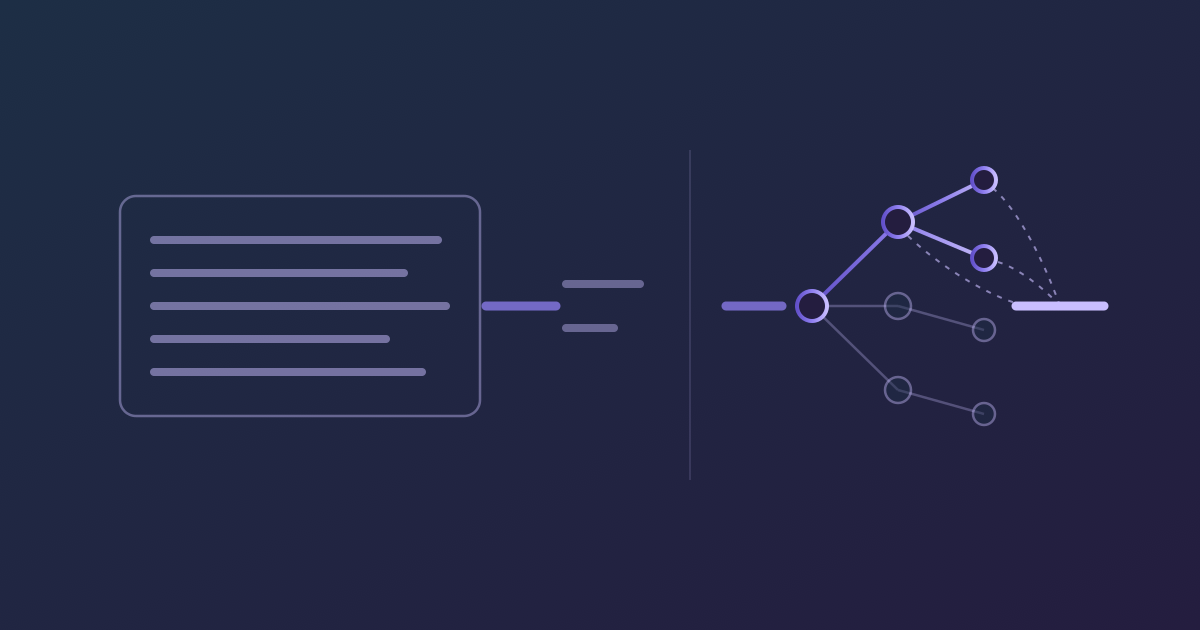
Underneath the noise there is a real distinction, and it takes about a minute to learn. A generative system is handed a window of text and produces a continuation. An agentic system is handed a model of a story it can navigate, and its unit of work is a sequence of reads over that model before it answers.
That sounds like a difference of degree. It is closer to a difference of job description. What follows is what the distinction is, what it emphatically does not mean, and four questions you can put to whichever tool is open in your other tab.
What is generative AI, actually?
A generative system is handed a window of text and asked what comes next. Its whole unit of work is emitting the next span. It is not shallow or stupid — it is doing exactly the job it was built for, on exactly the material it was handed.
The material is the constraint. Whatever did not fit in the window is not something it declined to consider; it is something it never saw. So the output is fluent, locally sensible, and unrelated to the book it sits inside. That is not a scandal — it is what a smarter word processor with a chat panel is built to do, and for a throwaway line of description it is often enough.
It becomes a problem the moment you want the tool to be right about something rather than plausible about it. It is not that generative tools are bad at consistency. Consistency is not the kind of thing they are shaped to have an opinion about.
What makes an AI agentic?
An agentic system is handed something it can navigate — a structured model of the story rather than a flat block of text — and it does a sequence of reads over that model before it answers. The unit of work is the reading, not the writing.
Concretely, a system of this kind consults the character sheet before it says how she would react; checks the established sequence of events before it places one; looks at what an act was meant to accomplish before it says what a scene in it is for. None of that produces prose. All of it happens first.
| generative | agentic | | --- | --- | | Handed a window of text | Handed a structure it can navigate | | Unit of work: emit the next span | Unit of work: a sequence of reads, first | | The context is assembled by you, by pasting | The context is assembled by the system, by looking | | Nothing to cite — there was no retrieval | The reads are the answer's sources | | Limited by what fits in the window | Limited by what the structure records |
It helps to read agentic as an axis rather than a switch, because systems sit at different points along it. The first rung is retrieval: the system finds and reads the parts of a structured story that bear on your question. The second is citation: it can tell you which parts those were. The third is further out — a story whose elements act, rather than a story an AI reads.
Where does Sagaly sit on that axis? Worth stating plainly. Sagaly is the AI-native fiction writing application for the modern author, and AI-native here means agentic, not generative. The first two rungs are what the first release is being built to stand on: the collaborator will read the elements of your story before it responds, and it will cite the ones it drew from. The third rung is direction — where the product is headed, not what release one will do. It gets its own section at the end, labeled as such.
And the third rung is not the second with the dial turned further. On the first two, the AI does the reading. On the third, the reading is not the point at all: the elements themselves will be the ones acting. That is a change of kind, not the next notch — and an axis is a dishonest way to draw it if it leaves you thinking the far end is nearly here.
It doesn't mean autonomous
Search the phrase and nearly everything you find was written for enterprise software. In that literature agentic means the system acts without you: it files the ticket, books the thing, closes the loop, and the human in the process is friction to be engineered out. That is a coherent ambition for an expense report.
Applied to a novel, it describes the product you already turned down. You have seen what unattended generation does to a manuscript: prose that is not in your voice, details it invented on the spot, "help" that walks straight through a rule your world is built on. Nobody who has cleaned that up wants more of it running while they are away from the desk.
So it is worth being blunt about the sense that matters here. Agentic means more reading before it speaks, not more acting without you. Reading agency, not authoring agency. Sagaly is not an AI that writes stories. Sagaly is designed so that you are the author and the AI is the collaborator.
A system of this kind earns the adjective by how much it consults before it offers you anything — never by how much it is permitted to do while nobody is watching.
The difference you can check
Here is the second-order consequence, and it is the useful one: an agentic system can be asked to show its work. A generative one has nothing to show.
A generative assistant produced a continuation. There was no retrieval step behind it, so there is no list of things it consulted. Asking "where did you get that?" is not a missing feature — it is a category error. There was never anything to point at.
An agentic system's unit of work is the reads. They exist, so they can be recorded and handed back. That is not a virtue somebody decided to have — it is a structural consequence: a system that had to look something up can tell you what it looked at.
Which gives you a test that needs nobody's marketing claims. Four questions, against any tool you already pay for:
1. What does it read before it answers? Not what it could see — what it actually consults. If the honest answer is "the last few thousand words of this document, plus whatever you pasted," you are using a generative tool, whatever the pricing page calls it.
2. Who assembled that context — you, by pasting, or the tool, by navigating? If you assembled it — pasting the character sheet, maintaining a preamble, re-briefing at the top of every session — the navigation is being done by a person. That person is you, and you are doing it inside the ninety minutes you set aside to write.
3. Can it show you what it read? Ask it. A system that retrieved something can name it. A system that did not will give you a confident-sounding claim about your own book and no way to check it short of checking it yourself — which is the work you were trying to avoid.
4. Who commits the change? This is where agentic most often gets quietly translated back into autonomous, so: at first release Sagaly's collaborator will be read-only. It will read and it will answer, and it will have no path to write into your manuscript at all. That is a statement about where a collaborator starts, not a permanent ceiling — but it is the sharpest form of everything above. Agentic describes how much it reads, not how much it is allowed to do.
Why this needs structure
None of this runs on a flat manuscript. Reading before answering presupposes there is something addressable to read — a story that exists as parts a system can ask for by name rather than as one long undifferentiated file. Sagaly is designed so that structure enables intelligence, and the typed element hierarchy is what that commitment is being built on. Ask your story a question — and Sagaly will answer from your own canon. The longer argument for why the tool needs something to see is its own post.
How far does the axis run?
Further than anything shipping. Here is the direction, labeled as direction: the far end is not an AI that reads your story better. It is a story whose elements will act on their own — and that is where Sagaly is going, not where Sagaly is today.
Not an AI that writes your story, but an engine that will simulate it into being. A cast that will remember is the shortest way to put it: every character, every location, every object, and the structural levels of the narrative themselves will hold a private, evolving memory of what they went through, and they will be placed under authored constraints and made to collide, so that the path between two authored points will be discovered rather than scripted. Authored destination, emergent path.
Three things will follow from that memory, and each is worth naming on its own, because each is something generated text structurally cannot hold.
Continuity. Elements will carry their own history forward — across a scene, across a book, across a series — so that what a character will bring into a late chapter will be what the early chapters actually did to her.
Subjectivity. Each element will know only what it witnessed. Two people in the same room will come away with different accounts of it, not because the system will have made a mistake, but because each will have been standing somewhere different.
Dramatic irony. An element will be able to be wrong. It will be able to be lied to, or to hold a belief you as the author know is false, because its memory will be allowed to diverge from what actually happened. This is the one a generative tool cannot reach at any scale: it can describe a character being wrong, but there is no one inside the text to be wrong.
Notice what changed between rung two and this one: the elements are the ones doing something, and the AI's reading is no longer the interesting part. None of it is release one. Calling it direction is not modesty — it is the accurate word.
What to do with the distinction
The useful thing about a definition is that it lets you sort. You have one now, and it is not a marketing word — it is a question about mechanism. What did it read before it answered? Who went and got that? Can it show you? Who is allowed to commit? Run those four on the tool in your other tab. A good deal of what is sold as agentic answers the first with "whatever was in the window" and the third with a shrug.
That is the whole of the claim behind the word here, and it is smaller and more useful than the one the enterprise pitch is making. Not an AI that will do more of your work. An AI that will do more reading before it offers you anything at all. Sagaly is designed so that you are the author and the AI is the collaborator. Agentic is the name for the reading, not for the writing.